
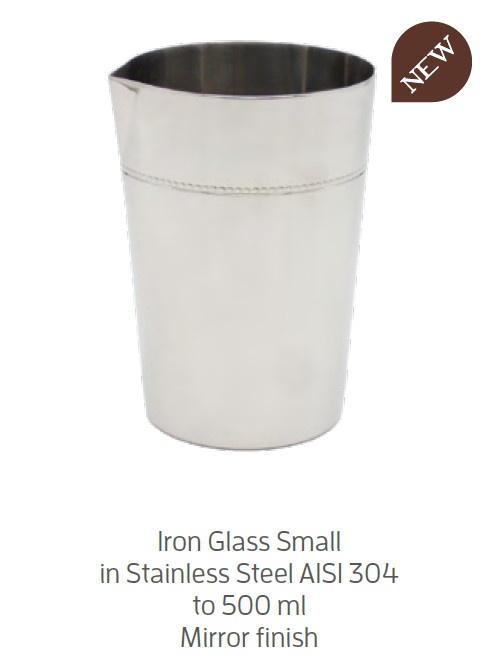

The Iron mixing tin in two lines
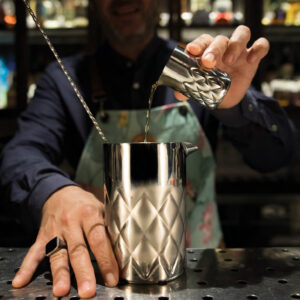
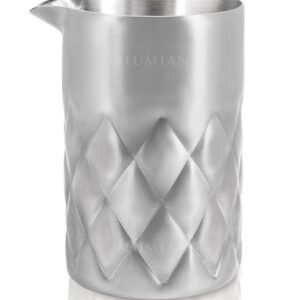
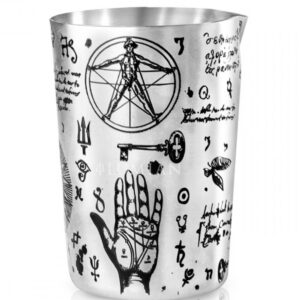
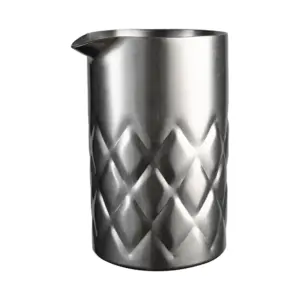
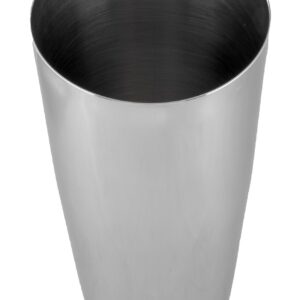
This is the Iron mixing tin in stainless steel: the vessel for stirred drinks in its plain form, with the thickness that holds the temperature and a balanced spout.
Who it is for
For anyone moving into stirred drinks without worrying about breaking anything. It is the piece you start working on stirred serves with when the bar is crowded or when the kit travels.
The thickness does the work
Thin metal chills fast and warms up just as fast; thick metal has a mass that, once chilled by the ice, stays cold and gives that temperature back to the liquid instead of taking it away. It is the same principle as the heavy base of a glass vessel, applied to the whole body. On the Iron mixing tin it is the feature the product rests on, because there is no air gap: there is the metal, and how much of it there is counts.


Specifications
- Material: stainless steel
- Construction: single wall with generous thickness
- Spout: balanced, for a continuous pour
- Use: stirred and strained technique
- Dishwasher safe: yes
Single wall or double
A double wall insulates better, and on a drink that sits in the vessel a while the difference is measured in dilution. A single wall, though, has two advantages: it costs less and it passes the cold to the hand, so it gives back the tactile reference insulation takes away. Anyone getting used to stirring often prefers to feel the chill rise, because it is one more signal alongside the frost.
The technique, which does not change
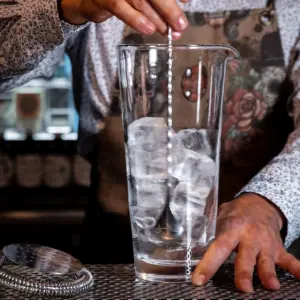
Ice to two thirds of the height, ingredients after, the spoon turning between thumb and forefinger with the bowl resting against the wall: you move the spoon, not the arm. You stop when the frost has risen on the outside, and on steel it arrives sooner than on glass because metal conducts better.
The strainer is still needed
The spout gives the line of the pour, it does not filter: the cubes are held back with a julep strainer set inside on the ice, or with a hawthorne on the rim. On a metal vessel the julep works better, because the rim of a tin is thinner than that of a mixing glass and a spring grips it less well.
Care
Dishwasher permitted, it is bare stainless steel with no finish to spoil. Dry it to avoid limescale marks, which show from a distance on polished metal, and check the edge of the spout now and then, since it is the thin part and the first to deform in a fall.
FAQ
What is the difference from the double walled models? Those insulate better; this one passes the cold to the hand and costs less.
How much ice goes in? Up to two thirds of the height, before the ingredients.
Do I need a strainer? Yes: on the Iron mixing tin the julep is the one that works best.
Can you see the ice turn? No, it is metal: the signal is the frost on the outside.
Is it right for working off site? Yes, and it is one of the reasons for choosing metal: it does not break in a bag.
The more you buy, the less you pay: 4 pieces -5%, 6 -7%, 8 -10%, on the same item.
Dispatched from Rome, Italy. 15-day returns, free of charge. Questions before you order? Message us on WhatsApp on +39 351 929 6937.
The other models, in glass and in steel, are in the mixing glass category.





Reviews
There are no reviews yet.