
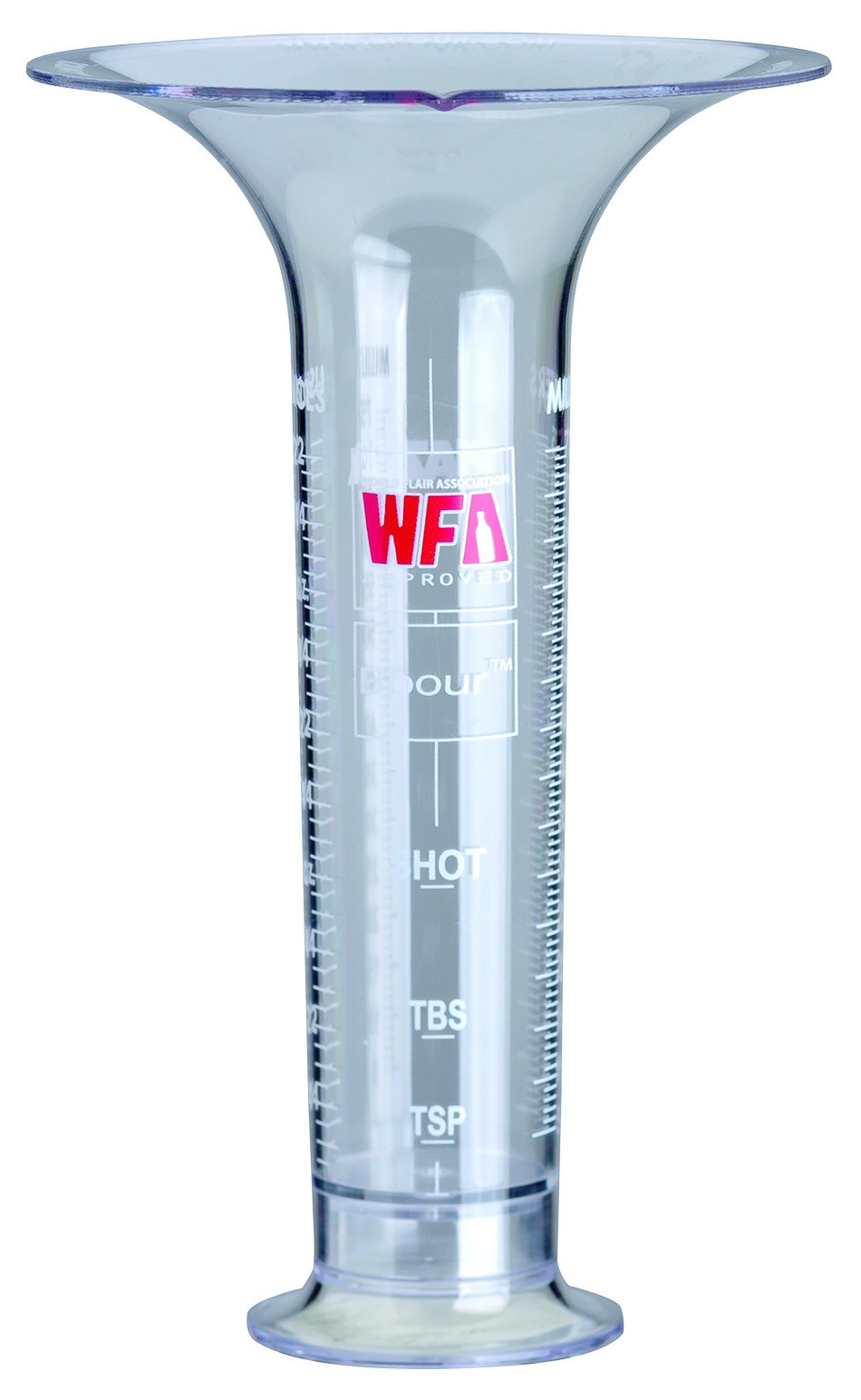

The pour tester in two lines
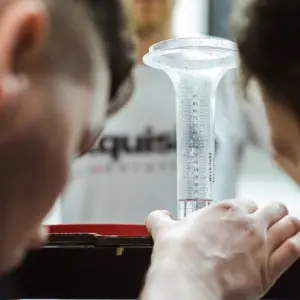
The Pour Check is the tool that measures how accurate you are pouring by hand with a metal pourer and a speed bottle: graduated in ounces and millilitres, reading to the quarter ounce with tolerances marked to the eighth, up to a capacity of 3oz.
Who it is for
For anyone running a bar where drinks are poured without a measure. Pouring by count is a serious technique, fast and good to watch, but it is also the only one where the error leaves no trace: nobody notices a drink poured heavy until the stock figures are read at the end of the month.
The count has to be recalibrated, not learned once
Anyone pouring by hand counts, usually four beats for an ounce and a half. The trouble is that the count depends on the spout, on the density of the liquid and on how full the bottle is: the same count on a new bottle and on a half empty one gives two different measures. A pour tester is there to reset that count every time something in the kit changes, and that is why it belongs behind a working bar and not only in a school.
Specifications
- Maximum capacity: 3oz, meaning 90ml
- Graduation: to the quarter ounce, in ounces and millilitres
- Tolerances: marked to the eighth ounce
- Material: polycarbonate
- Weight: 0.06kg
- Dimensions: 15 x 18 x 11cm
How to run a proper check
With water, not with spirit, and over at least ten pours. Read the average, which tells you whether the count is calibrated, and the spread, which tells you whether the hand is consistent: they are two different faults and they are corrected in different ways. A wrong average is fixed by changing the count, a wide spread is fixed only by repeating the movement until it settles.
What differs from the other Pour Check in the catalogue
The specifications declared by the supplier are the same: same capacity, same graduation, same material. What changes is the maker, the price and the declared outer dimensions. We write this because it is what a customer sees comparing the two pages, and until the supplier clarifies the difference we have no technical reason to give for choosing one over the other.
Polycarbonate takes the knocks
It is the right material for a tool that passes from hand to hand through a training session: it does not chip and it does not send fragments into the liquid. It does scratch over time, and scratches make the markings harder to read, so it wants a soft sponge and never an abrasive.
Counted pours and jiggers are not in competition
Almost every bar uses both: the counted pour on long drinks and long builds, where an error of 2ml disappears, and the measure on built specs, where the same error shows. A pour tester tells you where that line falls in your own case, meaning how accurate you actually are: someone inside an eighth of an ounce can pour by hand on far more things than someone swinging twice that.
The polycarbonate ages, the number does not
A checking tool has one job, to tell the truth about the measure, and it does it as long as the markings stay readable. So it pays to keep it away from abrasives and knives, and to replace it once the graduation gets hard to read against the light: a worn tester that reads badly is worse than no tester, because it gives an answer that gets trusted for no reason.
FAQ
How much does the pour tester hold? Up to 3oz, meaning 90 millilitres.
How is it graduated? To the quarter ounce, with tolerances to the eighth, in ounces and in millilitres.
Which liquid do you test with? Water: checking should not cost spirit.
What is the difference from the other model in the catalogue? The declared specifications match: the maker, the outer size and the price change.
What is it made from? Polycarbonate, which takes knocks.
The more you buy, the less you pay: 4 pieces -5%, 6 -7%, 8 -10%, on the same item.
Dispatched from Rome, Italy. 15-day returns, free of charge. Questions before you order? Message us on WhatsApp on +39 351 929 6937.
The other measuring tools are in the jigger guide.

Reviews
There are no reviews yet.