
Bar Tools
Mixing Glasses
The mixing glass is the only glass tool that works with your hands in the ice. When it breaks you are not paying for the glass: you are paying for the ice well to be emptied and for the service stopped while it is sanitised. Here are the mixing glasses, plus the steel mixing tins for anyone who would rather not run that risk. Below, how to choose.
23 products selected
-
Add
-
Add
-
 Mixing GlassesAdd
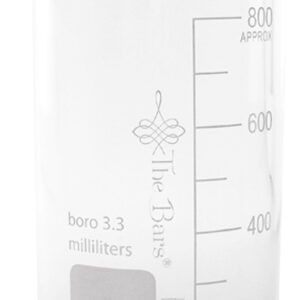
Beaker Mixing Glass 800ml, Graduated, with Spout
Original price was: 9,90 €.7,92 €Current price is: 7,92 €. ex VAT -
Add
-
Add
-
Add

- Options
-
Add
Choosing a mixing glass: technique, temperature control and handling
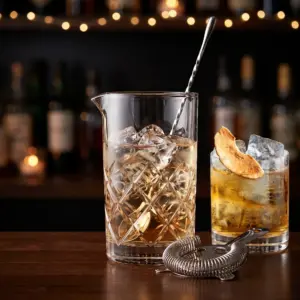
The mixing glass is the tool for drinks that are stirred and strained: from classics such as the Negroni, Manhattan and Dry Martini to signature serves built on liqueurs and clear spirits. Unlike the shaker, it adds no air: its job is to chill and dilute while keeping the silky texture and the clarity of the drink.
The range has 23 lines: 15 models in glass or crystal glass and 8 mixing tins in stainless steel, covering every style of service.
Glass, crystal or steel: how to choose
The material changes the feel in the hand, the temperature of the drink and the workflow at the bar:
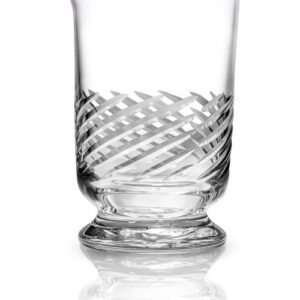
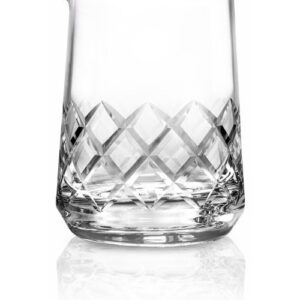
- Glass and crystal (the ritual on show): The bartender and the guest can watch the stir, the movement of the ice and the level of dilution. From classic diamond cuts (the Yarai style) that play with the light to smooth, plain walls, they put the movement on display.
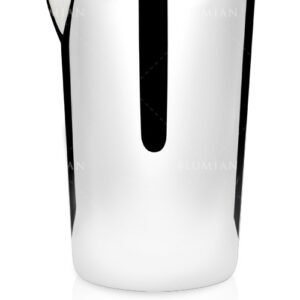
- Stainless steel (speed and cold): Metal mixing tins pass the cold through at once. Models such as the Akira, at 225 grams against more than 600 grams for a heavy 700ml glass, take strain off the wrist during a long, fast shift.
- Insulated double wall: Available on five steel models (Akira, Iron 600ml, Iron Vintage, Tiffany, Narita), it holds the temperature inside for longer and stops condensation forming outside, so the grip stays firm and dry.
Capacity and portions: a guide to sizes
Seventeen of the 23 models state an exact capacity, for single drinks or several at once:
| Capacity band | Glass and crystal | Stainless steel | Use |
|---|---|---|---|
| Up to 600ml | 1 (compact Yarai) | 4 | One drink at a time (single serve) |
| 650 to 700ml (standard) | 8 | 0 | The all-round size for 1 or 2 drinks stirred together |
| 750 to 860ml (multi-serve) | 3 (e.g. Scagner 860ml) | 1 (Akira 750ml) | Several drinks at once (up to 3 or 4 in one stir) |
| Not stated | 3 | 3 | (ask us) |
On the bar: if you often make double or triple orders, go for 700ml or more, so the ice turns freely round the bar spoon without jamming.
Speed: the graduated mixing glass
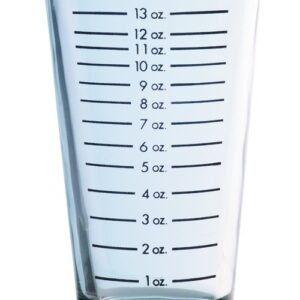
For high-volume stations, the Graduated Mixing Glass has measuring marks printed on the body of the glass. You pour and measure each part of the spec straight into it, without reaching for the jigger between ingredients. On an equal-parts spec with three ingredients, it halves the movements before the stir begins.
Three construction details that make the difference
The gap in price between the entry model and the professional pieces comes down to three construction details:
- Heavy base and low centre of gravity: Models such as the Nishi 700ml (about 600g) sit firmly on the station and stay still while the bar spoon turns hard, without the hand having to grip.
- Shaped drip-free spout: Cut clean to stop the flow precisely into the coupe or tumbler, without drips on the bar top.
- Heat-resistant walls: Glass and crystal made to take constant contact with ice and frequent commercial wash cycles.
Sold singly, with advice when you need it
Every mixing glass in the range is sold as a single unit, with no sets or multipacks, so you can replace or add to the station one piece at a time.
The stock shown on each product page comes straight from our warehouse. If you need a model with a specific height, weight or a diameter that fits your usual julep strainer, message us on WhatsApp for technical advice.
What goes with it for stirred drinks
To complete the stirring station:
- Bar spoon: 30 to 40cm long, with a twisted shaft for a smooth turn along the walls.
- Julep strainer: the traditional perforated bowl, holding large cubes inside the mixing glass.
- Hawthorne strainer: with a tight spring that holds back even small ice chips for a clear pour.
Frequently asked questions
Glass mixing glass or steel mixing tin?
Glass and crystal let you watch the ice move and the dilution build. Steel passes the cold through faster and weighs less: the Akira weighs 225 grams against more than 600 for a heavy 700ml glass. Five mixing tins have an insulated double wall, which holds the temperature for longer and keeps the grip dry.
What capacity do I need?
Among the stated capacities the most common is 700ml, six lines out of 17: the size for one or two drinks stirred together. The 600ml mixing tins are enough for a single drink; for double or triple orders start at 700ml or more, where the ice turns freely round the bar spoon.
Why do some mixing glasses cost far more than others?
Three things written on the product pages make the difference. A heavy base keeps the glass still under a wet hand: the Nishi 700ml weighs 600 grams. The insulated double wall of the tins holds the temperature for the whole stir. A balanced spout ends the pour without dripping.
Can I buy a single mixing glass?
Yes. Every mixing glass in the range is sold as a single unit, with no sets or multipacks, so you can replace or add to the station one piece at a time.
Which strainer goes with a mixing glass?
The julep strainer is the traditional choice: it holds large cubes inside the mixing glass during the pour. The Hawthorne, with its spring, is also used and holds back smaller ice chips.
Can't find what you need?
Tell me what you are looking for